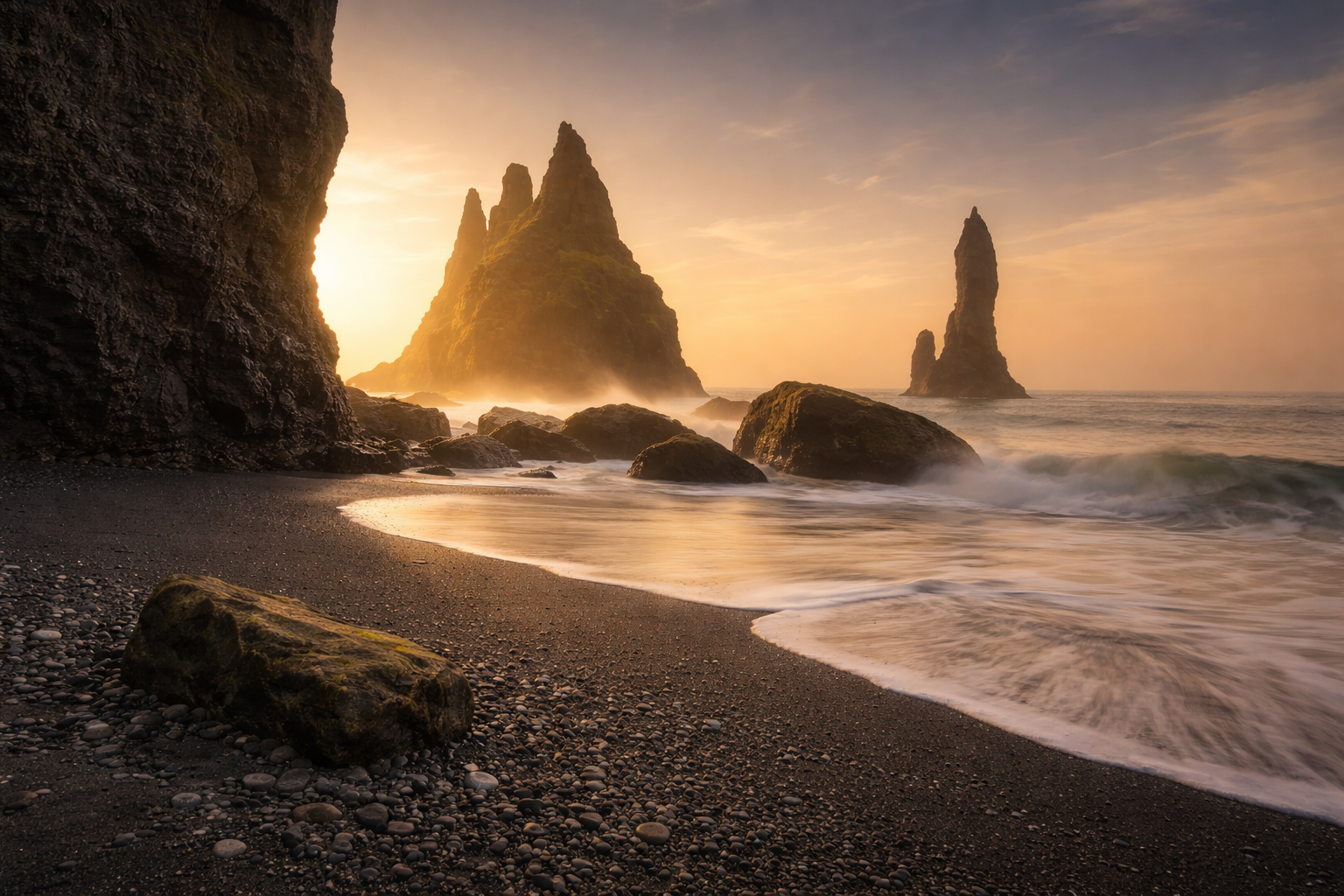
Iceland’s black sand beaches are formed from basalt lava flows, ground down by glaciers and the sea into jet-black volcanic sand. They're one of the most-photographed features of the South Coast road trip, stretching from Reynisfjara near Vík to Diamond Beach further east.
Check live dates and prices for the South Coast, waterfalls & Reynisfjara black sand beach tour from Reykjavík (4.8★, 12,000+ reviews):
The landscape ranges from towering basalt sea cliffs and hexagonal rock columns at Reynisfjara to crystal-clear glacial ice stranded on the sand at Diamond Beach—each beach shaped by a different combination of lava, glacier, and ocean.
This guide covers the top black sand beaches in Iceland, where to find them, essential safety tips for dangerous sneaker waves, and practical advice for your visit.
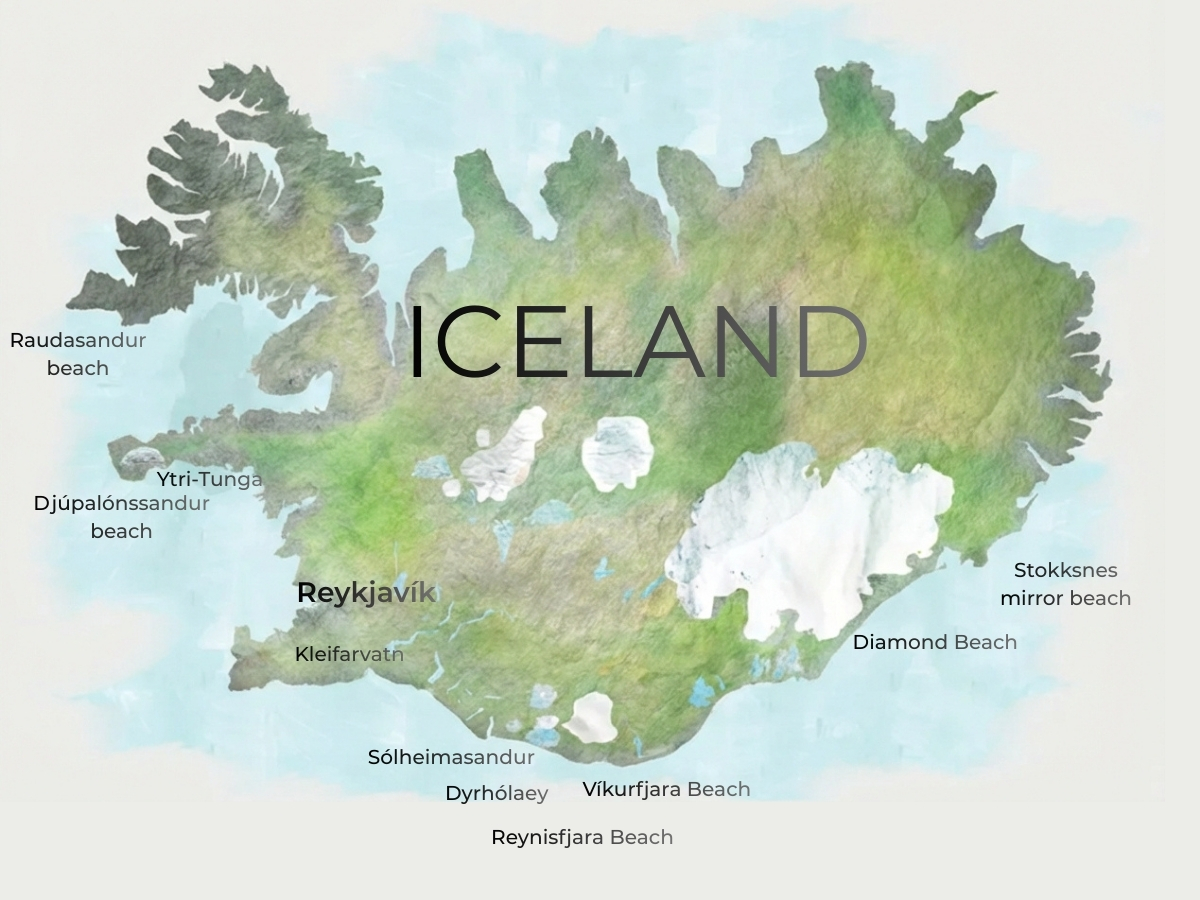
Top 10 Black Sand Beaches in Iceland
While Reynisfjara is the most famous, Iceland is home to numerous black sand shores. Here is our list of the best black sand beaches to include in your itinerary:
- Reynisfjara (South Coast) – Best for: Iconic basalt cliffs and Reynisdrangar sea stacks.
- Diamond Beach (Southeast) – Best for: Glittering glacier icebergs on jet-black sand. Diamond Beach Iceland guide
- Sólheimasandur (South Coast) – Best for: The famous US Navy DC-3 plane wreck on a desolate black beach.
- Stokksnes/Vestrahorn (Southeast) – Best for: Mirror reflections of the Vestrahorn mountain in wet sand and dunes.
- Dyrhólaey (South Coast) – Best for: Massive rock arches, panoramic coastal views, and Atlantic puffins.
- Djúpalónssandur (Snæfellsnes) – Best for: Black pebbles, rusted shipwreck remains, and ancient lifting stones.
- Raudasandur (Westfjords) – Best for: Solitude and a unique red-colored beach contrasted against black cliffs.
- Vikurfjara (Vík Village) – Best for: Easy accessibility directly from the village of Vík with views of Reynisdrangar.
- Ytri-Tunga (Snæfellsnes) – Best for: Seal watching on a hybrid golden-and-black sand beach.
- Kleifarvatn (Reykjanes) – Best for: A desolate, lunar-like volcanic lake setting near the airport.
Comparison Table: Iceland's Volcanic Shorelines
| Beach | Region | Best For | Time Needed | Safety Note |
|---|---|---|---|---|
| Reynisfjara | South Coast | Basalt Columns | 1–2 Hours | Dangerous waves |
| Diamond Beach | Southeast | Glacial Ice | 1–2 Hours | Sneaker waves |
| Sólheimasandur | South Coast | DC-3 Plane Wreck | 1–3 Hours | Desolate walk |
| Stokksnes | East | Mountain views | 2 Hours | High wind/tide |
| Djúpalónssandur | Snæfellsnes | Pebbles/History | 1 Hour | Powerful surf |
Other Experiences You Might Enjoy
Many visitors combine Reynisfjara and Diamond Beach with a Golden Circle tour or a Reykjavík whale-watching trip. The tours below are pulled live from GetYourGuide and update automatically.
Best Time to Visit Iceland’s Black Sand Beaches
Both summer and winter offer drastically different experiences on Iceland's shores. The "best" time depends entirely on what you want to witness.
Summer (June – August)
Best for: Long days, puffins, and easier driving.
- About 20 to 21 hours of daylight around the June solstice, with bright nights.
- Nesting puffins at Dyrhólaey and Westman Islands.
- Milder weather, though rain and wind persist.
- Boat tours running on Jökulsárlón, beside Diamond Beach.
Winter (November – March)
Best for: Northern Lights, ice blocks, and snowy contrasts.
- Optimal for Northern Lights reflecting in the wet sand.
- Largest concentration of icebergs at Diamond Beach.
- Stark, dramatic "Fire and Ice" aesthetic.
- Challenging driving; 4x4 strongly recommended.
[Internal link: Best time to visit Iceland]
Photography Tips for Volcanic Shores
Photographing black sand requires managing extreme tonal ranges—the dark basalt vs. the brilliant white of glacial ice or sea foam.
- Shutter Speed: Use 1/4 to 3 seconds for "painterly" water movement. For "silky" long exposures, use 20+ seconds with a 6-stop ND filter.
- Exposure Compensation: Bright ice on dark sand can fool your camera's meter. Use exposure compensation or manual mode to ensure the "diamonds" stay bright without washing out.
- Protect Your Gear: Salt spray and volcanic sand are relentless. Bring lens cloths, a waterproof cover, and never change lenses directly on the beach.
- Foreground Interest: Use chunks of ice or basalt pillars to create depth in your compositions.
Planning Your Visit: Tours vs. Self-Drive
Most visitors arrive via self-drive or guided tours, each offering distinct advantages.
Self-Drive
Offers the most autonomy. You can stay for sunrise or sunset and explore lesser-known beaches like Stokksnes at your own pace. A 4x4 is highly recommended in winter.
Guided Tours
Ideal for those uncomfortable driving in Iceland's volatile weather. Tours from Reykjavík handle the logistics and provide educational commentary. [Internal link: Ice cave tours near Jökulsárlón]
Frequently Asked Questions
It is volcanic in origin, composed of basaltic fragments created when molten lava meets the cold Atlantic ocean and shatters into tiny pieces.
No, there are dozens. However, it is the most famous due to its basalt columns and proximity to Vík.
Absolutely not. The currents, freezing temperatures, and sneaker waves are lethal. Stay at least 30 meters from the water.
Reynisfjara is about 2.5 hours away, while Diamond Beach is approximately 5 hours away along the South Coast.
In summer, most South Coast beaches are accessible by 2WD. In winter, a 4x4 is strongly recommended due to snow and ice on the roads.
No. Removing natural objects is illegal in many areas (like Djúpalónssandur) and discouraged everywhere to preserve the environment.
Most beaches are free to visit, though some locations like Stokksnes have a small entry fee, and many parking lots now require payment via apps like Parka.
It is a modern nickname (real name: Breiðamerkursandur) due to how the icebergs from Jökulsárlón glisten like diamonds on the dark sand.
Ready to experience the surreal beauty of Iceland’s volcanic coast? Whether you stand among the "diamonds" of Breiðamerkursandur or beneath the pillars of Reynisfjara, these beaches will be a highlight of your journey.