Picture a lake where thousand-year-old icebergs the size of apartment buildings drift across near-freezing water, seals bob among the ice and a wall of glacier glows blue on the horizon. That is Jökulsárlón, Iceland’s deepest lake, directly across the Ring Road from Diamond Beach. Here is how to see the lagoon (boat tours, seals, prices, when to go and how to stay safe), and what else lies within an hour of the beach: Fjallsárlón, the ice caves, Skaftafell, Höfn and the South Coast stops on the way from Reykjavík.
Check live dates and prices for the classic South Coast, Diamond Beach & Jökulsárlón day tour from Reykjavík (4.5★ from 1,571 reviews on GetYourGuide):
What’s Near Diamond Beach?
Most visitors combine several of these in one trip. Distances are from the Diamond Beach car parks:
| Attraction | Distance | Drive time | Highlight |
|---|---|---|---|
| Jökulsárlón Glacier Lagoon | 0.5 km | Walk (path under the bridge) | Floating icebergs, seals, boat tours |
| Fjallsárlón Glacier Lagoon | 10 km | 10–15 min | Smaller, quieter lagoon |
| Vatnajökull ice caves | 20–50 km | 30+ min | Blue ice caves (winter, guided only) |
| Skaftafell / Svartifoss | 55–60 km | 45 min | Hiking, basalt waterfall, glacier walks |
| Höfn | about 65 km | under 1 hour | Langoustine, glacier views |
Jökulsárlón Glacier Lagoon
Distance: directly opposite Diamond Beach (a walking path runs under the Route 1 bridge)
Jökulsárlón (pronounced roughly YOH-kuls-OWR-loan) is a large glacial lake in southeast Iceland, on the southern edge of Vatnajökull National Park. The name means “glacial river lagoon”, from the Icelandic words jökull (glacier), á (river) and lón (lagoon). Icebergs calve from Breiðamerkurjökull glacier, float in the deep, milky-blue lagoon and drift out to sea, where some wash up on Diamond Beach.
It holds several records:
- Iceland’s deepest lake: about 248 metres (814 feet) at its deepest point, according to the Natural Science Institute of Iceland. An earlier sounding by Einar B. Einarsson, owner of the local excursion company Ice Lagoon, gave a higher figure; as Iceland Review reported, “It turned out to be 284 meters. Until now, Öskjuvatn Lake has been considered to be Iceland’s deepest lake, at 217 meters.”
- Iceland’s largest glacial lagoon: roughly 18–25 square kilometres, and still growing.
- Fed by Breiðamerkurjökull, an outlet glacier of Vatnajökull, Europe’s largest ice cap by volume.
The lagoon reaches the Atlantic through the Jökulsá, one of Iceland’s shortest rivers (under 1 km long), which runs beneath the Route 1 bridge. Because the tide pushes seawater in, the lagoon is brackish, a mix of glacial meltwater and sea, which shapes both its colour and its wildlife.
Since 5 July 2019, Jökulsárlón has been part of the Vatnajökull National Park UNESCO World Heritage Site, inscribed as “Vatnajökull National Park – Dynamic Nature of Fire and Ice.” UNESCO describes the property as covering “over 1,400,000 ha, nearly 14% of Iceland’s territory,” with “ten central volcanoes, eight of which are subglacial.”

Visit both
Allow at least 90 minutes for Jökulsárlón and Diamond Beach together. Park at either lot and walk between them on the path under the bridge instead of crossing the road.
How Jökulsárlón formed: a lake made by a retreating glacier
Jökulsárlón did not exist a century ago. When Iceland was settled around AD 870, the Breiðamerkurjökull glacier tongue sat roughly 20 km further north. During the Little Ice Age (1600–1900) it advanced almost to the ocean. As the climate warmed after about 1920 the glacier began to retreat, and a lake formed in front of it around 1934–1935. It has been growing ever since:
- In 1975 the lagoon covered about 8 square kilometres.
- Today it covers roughly 18–25 square kilometres, more than four times its size in the 1970s.
- It became Iceland’s deepest lake as the retreating ice deepened its basin.
The glacier is still pulling back fast. The Icelandic Meteorological Office reports that Breiðamerkurjökull retreats “with an annual rate of retreat in recent years of 200–300 m,” and that calving into the lagoon causes about one third of the glacier’s mass loss. The lagoon is a beautiful sight and a visible record of climate change.
The icebergs: blue, white and 1,000 years old
The icebergs calve from the face of Breiðamerkurjökull and drift slowly across the lagoon toward the sea. Some are as small as a car; others are as tall as a six-storey building, with about 90% of their mass hidden underwater. Their colours tell you what they are made of:
- Brilliant white ice is full of trapped air bubbles.
- Electric blue ice is dense, old ice, compressed over centuries until nearly all the air was squeezed out.
- Black and grey streaks are volcanic ash from past eruptions of the volcanoes beneath Vatnajökull.
The ice at the heart of the largest bergs can be more than 1,000 years old. Icebergs may float in the lagoon for years before they are small enough to drift out through the Jökulsá river into the Atlantic, and the tide washes some of them back onto the black sand of Diamond Beach. Our Diamond Beach Complete Guide tells the rest of that story, and 1,000-year-old ice explains what is locked inside it.
Other Experiences You Might Enjoy
Beyond the lagoon itself, visitors here often add a Jökulsárlón kayak tour, a Skaftafell glacier hike on Vatnajökull, a winter blue ice cave tour from the lagoon car park, the Fjallsárlón boat tour, or, back in Reykjavík, a Golden Circle day and a whale watching trip. The tours below are pulled live from GetYourGuide and update automatically.
Where Jökulsárlón is and how to get there
Jökulsárlón sits right beside Route 1 (the Ring Road) in southeast Iceland, roughly halfway between Vík and Höfn, at approximately 64.0784° N, 16.2306° W. Approximate driving distances and times:
- Reykjavík: ~380 km (about 5 hours’ direct drive)
- Vík: ~190 km (about 2.5 hours)
- Skaftafell: ~55–60 km (about 45 minutes)
- Höfn: ~65 km (under an hour)
- Fjallsárlón: ~10 km west (about 10–15 minutes)
Most visitors drive themselves. The road is paved and open to any vehicle year-round, though winter weather calls for caution, so check road.is and vedur.is before you set off. The alternative is a guided Jökulsárlón and Diamond Beach day tour from Reykjavík (4.7★ from 4,047 reviews on GetYourGuide), a long day of roughly 12–14 hours, or a multi-day tour (4.9★ from 79 reviews on GetYourGuide) that breaks the drive up. Our how to get there guide has the full route.
Parking: in 2026 parking costs 1,110 ISK for a car with up to five seats (1,440 ISK for six to nine seats), plus an 89 ISK payment fee, paid through the Parka app or the machines in the lots. One payment covers all three lots (the main lagoon lot and both Diamond Beach lots) until midnight. If you also park at Skaftafell, another fee area of the national park, on the same day, the second site is half price.
Boat tours on Jökulsárlón
The best way to see the lagoon is from the water. The main operator is Glacier Lagoon (icelagoon.is), and its two boats run different seasons: amphibian tours from May to November and Zodiac tours from May to the end of October, weather and ice permitting. Book ahead in peak summer.
Amphibian boat tours
- What it is: a large amphibious vehicle that drives down the bank and floats straight into the lagoon.
- Duration: about 30–40 minutes.
- Best for: families and first-timers. It is stable and relaxed, and there is no minimum age.
- Price (2026, operator): icelagoon.is lists “Adults 13+ / 7100 ISK · Children age 6-12 / 3500 ISK · Children age 0-5 / 0 ISK.”
- Highlights: a guide talks through the geology, and the crew often fish out a chunk of 1,000-year-old ice for you to touch.
Without a car, the Glacier Lagoon boat ride and Diamond Beach day tour from Reykjavík (4.7★ from 321 reviews on GetYourGuide) includes the amphibian boat ride during the boat season.
Zodiac (RIB) boat tours
- What it is: a small, fast rigid inflatable that covers far more of the lagoon, travelling roughly 8 km toward the Breiðamerkurjökull glacier wall.
- Duration: about 1 hour 15 minutes in total.
- Best for: adventurous visitors and photographers who want to get as close as the boats go to the calving glacier face.
- Minimum age: 10 years old, or at least 130 cm tall.
- Price (2026, operator): icelagoon.is lists Zodiac tours at 16,600 ISK for adults (13+) and 8,300 ISK for children (10–12).
Zodiac tours are booked directly with the operator at icelagoon.is.
Kayak tours
For a quieter trip, guided Jökulsárlón kayak tours (4.7★ from 530 reviews on GetYourGuide) paddle among the icebergs in the warmer months. Operators publish seasons of roughly May or June to September, with about 1.5 hours on the water and 1–3 hours in total; the usual minimum age is 14, though some operators take younger teenagers in a double kayak with an adult.
What to wear on any tour: dress warmly in layers even in summer, because it is always colder near the glacier. Bring a waterproof outer layer, a hat and gloves, and avoid cotton. Operators provide life jackets and, on Zodiac and kayak tours, flotation or dry suits.
Wildlife at Jökulsárlón
The brackish, fish-rich water makes the lagoon a wildlife hotspot.
- Seals: harbour seals live here year-round, swimming among the icebergs or hauled out on the ice. Most seals gather in winter.
- Birds: in summer, Arctic terns nest near the lagoon; keep your distance, because they dive-bomb intruders. Great skuas nest on the surrounding sands, and you may also spot fulmars, eiders, kittiwakes and gulls.
- Orcas: orcas hunt in the coastal waters of southeast Iceland, and lucky visitors occasionally glimpse them from the shore here, though sightings are rare. For a dedicated whale trip, see our whale watching guide.
Watch wildlife from a distance. Drones are restricted here: the national park bans flying at Jökulsárlón and Fellsfjara from 15 April to 15 July to protect nesting birds, sets flying hours for the rest of the summer, and never allows drones over the high-traffic zone by the car parks. Check the park’s current drone rules before you fly.
Best time to visit Jökulsárlón
You can visit the lagoon in any month, although winter weather affects the drive and the boat tours are seasonal. What you can do there changes with the season:
- Summer (June–August): both boat tours and kayaking are running, the weather is milder, the midnight sun keeps it light late, and nesting birds and seal pups are about. It is also peak season.
- Shoulder months (May, September–October): fewer visitors and excellent light for photography. The boat tours still operate, and autumn brings the first chance of aurora after dark.
- Winter (November–March): the lagoon is the starting point for blue ice cave tours, the dark skies are good for the northern lights, there are fewer visitors and often plenty of ice. Zodiac tours stop at the end of October and the amphibian boats stop during November, days are short and driving can be difficult.
Best time of day: early morning around sunrise, or evening light, when the light is softer, the water is calmer for reflections and fewer people are about. The ice is always moving, so the lagoon never looks the same twice. For a month-by-month breakdown, see our best time to visit guide.
Northern lights over Jökulsárlón
Jökulsárlón is one of Iceland’s best places to watch the aurora: there is almost no light pollution, and on a still night the lights reflect off the lagoon and the floating ice. The aurora season runs roughly from late August or September to mid-April, on clear, dark nights. For forecasts and timing, read our Northern Lights Complete Guide and our guide to the best time to see the northern lights.
Ice caves near Jökulsárlón
In winter, the Jökulsárlón car park is the main departure point for Iceland’s natural blue ice cave tours inside Vatnajökull. The caves form anew each winter, so no two seasons look the same, and tours typically run from around November to March. A typical tour starts at the lagoon, rides out in a modified super jeep to the edge of the glacier and finishes with a short walk into a cave glowing in shades of blue. You can only go with a guide. The Original Ice Cave Tour from Jökulsárlón (4.6★ from 1,207 reviews on GetYourGuide) is one of the longest-running; more options are in our ice cave tours guide.
Jökulsárlón on screen
The lagoon’s looks have made it a favourite of film-makers:
- James Bond: A View to a Kill (1985) and Die Another Day (2002), whose car chase was filmed on the frozen lagoon.
- Lara Croft: Tomb Raider (2001)
- Batman Begins (2005)
- Interstellar (2014), along with nearby Svínafellsjökull glacier
Practical information
- Cost to visit: walking the lagoon shore is free; you pay only for parking (1,110 ISK per car) and any boat, kayak or ice cave tour you add.
- Facilities: a café serving hot drinks, soup and light snacks, restrooms and small shops at the main site.
- How long to spend: 1–2 hours to walk the shore and cross to Diamond Beach; 3–4 hours if you add a boat tour.
- Accessibility: the main viewing area, café and restrooms are wheelchair accessible, but the shoreline paths are natural, uneven ground.
Safety at Jökulsárlón
Never climb onto the ice
Icebergs and floating ice can flip or roll without warning and can drift out to sea. Follow the official SafeTravel guidance.
- Do not enter the water. It stays around 0–3 °C all year; cold shock and hypothermia set in within minutes.
- Stay back from the edges and from the outlet channel, where the currents are strongest.
- Keep your distance from seals and nesting birds.
- At Diamond Beach across the road, never turn your back on the ocean: sneaker waves arrive without warning. See our safety tips.
What changed in 2025–2026
- Parking: 1,110 ISK per car (up to five seats) plus an 89 ISK payment fee, valid until midnight and covering the lagoon and both Diamond Beach lots.
- Boat tour prices (2026, operator): amphibian 7,100 ISK per adult; Zodiac 16,600 ISK per adult (icelagoon.is).
- Kilometre road charge: since 1 January 2026 Iceland charges a per-kilometre fee on all vehicles, 6.95 ISK per km for cars, with fuel taxes cut in exchange. Rental companies pass it on, some as a daily fee (Blue Car Rental charges 1,550 ISK a day in 2026) and some per kilometre.
Is Jökulsárlón worth visiting?
Yes. Jökulsárlón is consistently rated among Iceland’s best natural attractions, and many travellers call it the highlight of their trip. It puts floating icebergs, a glacier, year-round seals, dark winter skies for the aurora and Diamond Beach in one easy stop on the Ring Road.
Fjallsárlón Glacier Lagoon
Distance: 10 km west (~10–15 min drive)
A smaller, more intimate glacier lagoon that is often quieter than Jökulsárlón. The iceberg views are just as striking, and the glacier face is closer. The Fjallsárlón iceberg boat tour and glacier hike (4.8★ from 75 reviews on GetYourGuide) combines two short Zodiac rides on the lagoon with a two-hour walk on Fjallsjökull.

- Fjallsárlón Glacier Lagoon Ice Floating Tour
- Fjallsárlón Aurora Hut - Overnight Adventure
- Its own Zodiac boat tours and kayaking (seasonal)
- Small café on-site
- A good alternative when Jökulsárlón is busy
Vatnajökull Ice Caves
Distance: 20–50 km (varies by cave location)
From November to March, natural blue ice caves form inside Vatnajökull glacier. You can only visit them on a guided tour.
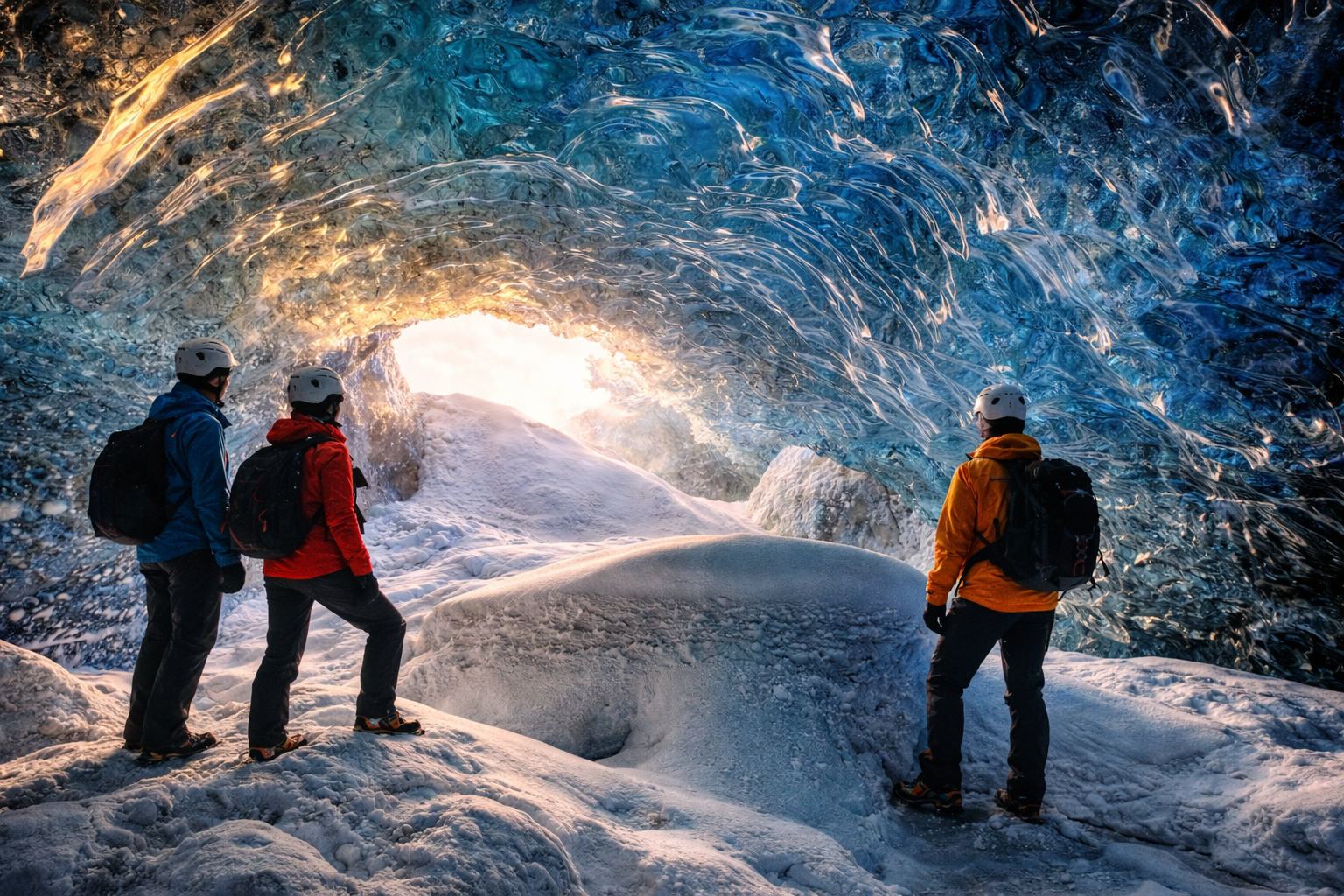
Key Information
- Season: mainly November to March
- Access: guided tours only (glacier safety)
- Book ahead: popular tours fill weeks in advance
- Starting points: Jökulsárlón or Hali (between the lagoon and Höfn)
Skaftafell & Svartifoss
Distance: 55–60 km west (~45 min drive)
Part of Vatnajökull National Park, Skaftafell is the park’s main hiking area (our complete Skaftafell guide covers the trails, fees and glacier trips). The most popular trail leads to Svartifoss (Black Falls), a waterfall framed by dark hexagonal basalt columns, and guided glacier hikes (4.7★ from 1,637 reviews on GetYourGuide) start here too. Nearby Svínafellsjökull is the glacier tongue seen in Interstellar and Batman Begins.

Hikes from Skaftafell
- Svartifoss: about 1.5 km each way (about 3 km return), 1.5–2 hours; the park’s Svartifoss–Sjónarsker–Sel loop is 5.8 km, about 2 hours
- Skaftafellsjökull glacier trail: 4.1 km loop, 1–1.5 hours, easy
- Kristínartindar: 18 km, 6–8 hours, difficult
Höfn
Distance: about 65 km east (under an hour’s drive)
The “Langoustine Capital of Iceland” is a fishing town with restaurants, accommodation and wide glacier views. It works as a base for ice cave tours and for the drive into east Iceland, and the Vestrahorn and Stokksnes photography beach is 15–20 minutes beyond it.

- Fresh seafood restaurants (try the langoustine)
- Glacier exhibition
- Accommodation options
- Gateway to the Eastfjords
On the Way from Reykjavík
If you’re driving from Reykjavík, these popular South Coast stops are on your route:
Seljalandsfoss
A 60 m waterfall you can walk behind (weather permitting), about 120 km from Reykjavík.
Skógafoss
A powerful, misty waterfall with a staircase to the top for wide views, 30 km past Seljalandsfoss.
Reynisfjara Black Sand Beach
Basalt columns and sea stacks near Vík, and Iceland’s most dangerous beach because of its sneaker waves. Read the safety rules in our black sand beaches guide before you go.
See our sample itineraries for how to combine these stops.
Jökulsárlón FAQ
Jökulsárlón is Iceland's deepest lake, about 248 metres (814 feet) at its deepest point according to the Natural Science Institute of Iceland. That puts it ahead of the previous record-holder, Öskjuvatn (220 m), and the lagoon keeps deepening as the glacier retreats.
About 380 km (roughly 235 miles), a direct drive of around 5 hours east on Route 1. With sightseeing stops, allow 7–8 hours each way, which makes a day trip a long 12–14-hour undertaking.
Yes. Family-friendly amphibian boat tours (about 30–40 minutes, no minimum age, 7,100 ISK per adult) run from May to November, and faster Zodiac tours that go closer to the glacier (about 1 hour 15 minutes in total, minimum age 10 or 130 cm, 16,600 ISK per adult) run from May to the end of October. Guided kayak tours run in the warmer months.
Jökulsárlón is the glacial lagoon where icebergs calve and float; Diamond Beach is the black sand beach directly across Route 1 where those icebergs wash ashore after drifting out to sea. They are twin attractions, best visited together.
You can visit in any month. Summer brings boat tours, milder weather, wildlife and the midnight sun; winter brings the northern lights, ice cave tours, fewer visitors and often plenty of ice. Early morning or evening light is best.
Yes to both. Harbour seals live in the lagoon year-round. And with its dark skies and reflective water, Jökulsárlón is one of Iceland's best northern lights spots during the aurora season, roughly September to mid-April.
Walking the lagoon shore is free. You pay for parking (1,110 ISK for a car with up to five seats, plus an 89 ISK payment fee, valid until midnight and also covering the Diamond Beach lots) and for any activity you add: boat tours from 7,100 ISK (amphibian) or 16,600 ISK (Zodiac) per adult, or a winter ice cave tour, which costs more.
Yes. It is one of Iceland's most-visited natural sights: a UNESCO-listed lagoon of ancient blue icebergs, seals and glacier views, right beside the Ring Road and paired with Diamond Beach.