Best Time to Visit Diamond Beach Iceland: Ice, Tours & Weather by Month
Diamond Beach can be visited year-round, while the activities around Jökulsárlón change with the season: boat tours run mainly from May into the fall, and natural ice cave tours are a winter experience. The amount of ice on the black sand does not follow a reliable monthly pattern: tides, waves, wind and the flow of ice out of the lagoon can change the beach within hours.
If your dates are already fixed, use the date checker below to see the forecast, daylight and which Jökulsárlón tours are running on your day, with links to check road conditions.
The short answer
Diamond Beach sits directly beside Route 1 and can be visited throughout the year, weather and road conditions permitting. The amount of ice on the sand changes from day to day, and even hour to hour, with the tides, waves, wind and the flow of ice out of Jökulsárlón. There is no reliable ice season: some visits have large amounts of ice and others much less. The season changes which tours run at the lagoon and on the glacier, and how much daylight you have for the drive.
If your dates are flexible, May and June offer the best overall balance for a first visit. Boat tours are running, daylight is very long and you are ahead of the July and August peak. June has the fuller summer boat schedule, and May is generally quieter. Zodiac tours on the lagoon usually run from May to October, while amphibian boats can continue until mid-November.
If a natural ice cave is the main reason for your trip, choose November to March, the core season. Some operators start in October or continue into April when conditions allow.
Late October and early November can occasionally give you an overlap between boat trips and ice cave tours, but do not plan around it without checking the exact operator schedules and conditions.
December to February makes a quieter winter trip, at a cost: short daylight, no boat tours on the lagoon, and roads and weather that matter much more than in summer. In return you get ice caves when conditions allow, and far fewer overnight stays in the area than in summer. If you are driving yourself, plan your time on Route 1 around the limited daylight.
Whatever month you come, check the wind, road conditions on road.is and your tour's status before setting out. At the beach, stay well back from the water's edge: Atlantic waves can run much farther up the black sand than expected, and large pieces of ice can move in the surf.
- Best overall, first visit
- May and June
- Zodiac boat tours
- May to October
- Amphibian boat tours
- May to mid-November
- Natural ice caves
- November to March
- Possible boat and ice cave overlap
- Late October to early November
- Warmest weather
- July and August, but busiest
- Quieter winter trip
- December to February
- Most useful live checks
- Wind · road status · tour availability · daylight
- Daylight at the beach, mid-June20h 57m
- Daylight at the beach, mid-December4h 17m
- Average day high in July, Fagurhólsmýri (30 km west)13.8 °C
- Average day high in January, Fagurhólsmýri3.9 °C
Live dates for a Diamond Beach day tour
If you are not driving yourself, a day tour from Reykjavík covers the 370 km each way and stops at both the beach and Jökulsárlón. This one, with 4,004 reviews, runs in winter and summer; the calendar below shows live dates and prices.
Check your travel date
Pick a date to see which tours run at the lagoon and on the glacier that month, the daylight, and the weather. Within about ten days of your date the card shows the Icelandic Met Office forecast for Kvísker, about 15 km west; further ahead it shows long-term averages from Fagurhólsmýri, 30 km west.
Pick a date above to see your day. Until then, this is the pattern through the year.
Zodiac boat tours on the lagoon run from May to October and amphibian boats into November; ice cave tours mainly from November to March.
- Daylight at the beach4h 17m mid-December to 20h 57m mid-June
- Average day high, Fagurhólsmýri3.9 °C in January, 13.8 °C in July
- Rain in an average month, Fagurhólsmýriover 100 mm in every month
- Guest nights in Hornafjörðurhighest in July and August
Beach walk: wind, rain or snow, temperature and daylight.
- Pick a date to see the wind and weather for the beach.
Boat tour on the lagoon: whether boats run that month, then wind and rain.
- Zodiac tours usually run from May to October, amphibian boats into November.
Ice cave tour: whether it is ice cave season, then wind and heavy rain or snow.
- The core ice cave season is November to March.
On the morning you drive, check road.is or umferdin.is, your tour operator's status, and the tide table for Höfn, the nearest published one. Forecast: Icelandic Met Office.
What each season is best for
May and June: best overall for a first visit
The boat tours on Jökulsárlón usually start in early May, so from May onward you can walk the beach and go out among the icebergs on the same stop. May is the sunniest month at the nearest weather station that records sunshine. June has the longest days, with 20h 57m of daylight in mid-June, so the drive from Reykjavík and back fits easily into daylight.
Both months come before the busiest part of the summer. Guest nights in Hornafjörður, the municipality around the lagoon, are about half the July and August level in May and about four-fifths in June. The days are cool: average highs are about 10 °C in May and 12 °C in June at Fagurhólsmýri, 30 km west.
July and August: warmest and busiest
July and August are the warmest months, with average highs of about 14 °C at Fagurhólsmýri, and the busiest, with the most guest nights of the year in Hornafjörður. The Zodiac on the lagoon runs up to 10 departures a day in high season, according to its operator. Until late July the sky stays in twilight all night.
September: boats still running, darker nights
September keeps the lagoon boat tours and brings back nights dark enough for the northern lights from early in the month, with 13h 07m of daylight in mid-September. It has about as many guest nights as June, and is one of the wettest months, with around 190 mm of rain at Fagurhólsmýri.
October: the last boats and the first ice caves
Late October and early November are when the two seasons can occasionally overlap: the Zodiac runs to the end of October, amphibian boats can continue into November, and some ice cave operators start their season when conditions allow. Neither is guaranteed on a given date, so check both schedules before you plan on doing the two together. The days are shorter, just under 10 hours in mid-October, and it is the wettest month at Fagurhólsmýri. October also has more guest nights than May.
November to March: ice caves and dark nights
Natural ice caves in Vatnajökull form in the cold months, and the core season for tours from the lagoon is November to March. The region's tourism office says the caves are accessible from November and usually through March, depending on the weather, and that they should never be entered without a glacier guide.
December and January have fewer guest nights than any other month, and the shortest days: 4h 17m of daylight in mid-December and 5h 24m in mid-January. February and March keep the ice cave season with much longer days, 8h 35m and 11h 38m in mid-month. Wind is strongest from November to April, and winter storms can temporarily close or restrict Route 1.
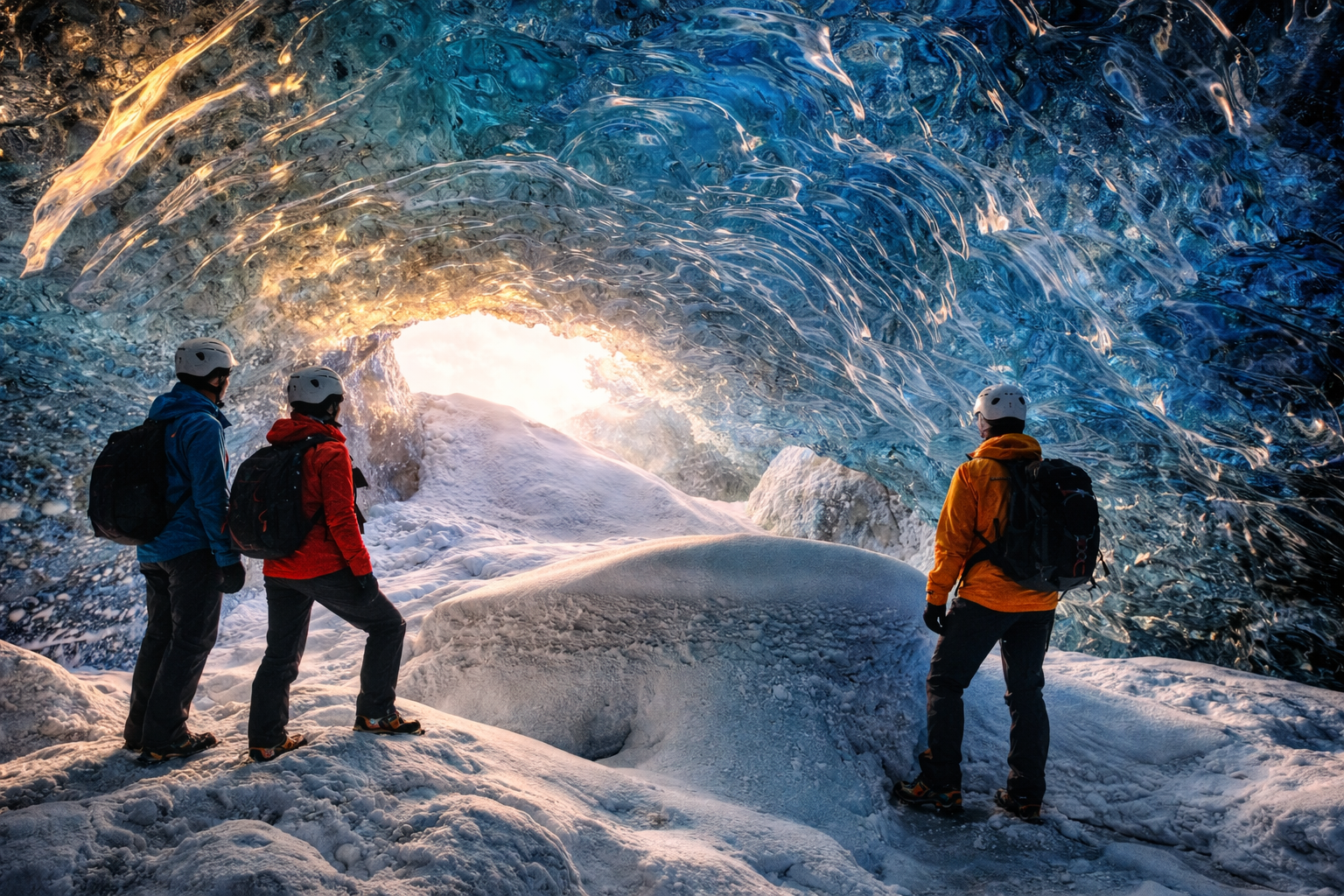
April: long days, before the boats
April has 15 hours of daylight in mid-month, and some ice cave tours continue into April when conditions allow, but the boats on Jökulsárlón usually do not start until early May. The boats on Fjallsárlón, a smaller lagoon 10 km west, run from April.
Wildlife through the year
Seals are seen in and around the lagoon in every season, often resting on the ice. Great skuas and Arctic terns are summer visitors, and Vatnajökull National Park describes the sands around the lagoon as an important nesting ground.
Other experiences on the glacier coast
Around Diamond Beach the season changes what you can book along the coast as well: boat tours on Jökulsárlón in summer, blue ice cave tours in Vatnajökull in winter, glacier hikes at Skaftafell, about 55 km west, and the smaller Fjallsárlón lagoon, 10 km west. Popular options below.
Is there more ice on Diamond Beach in winter?
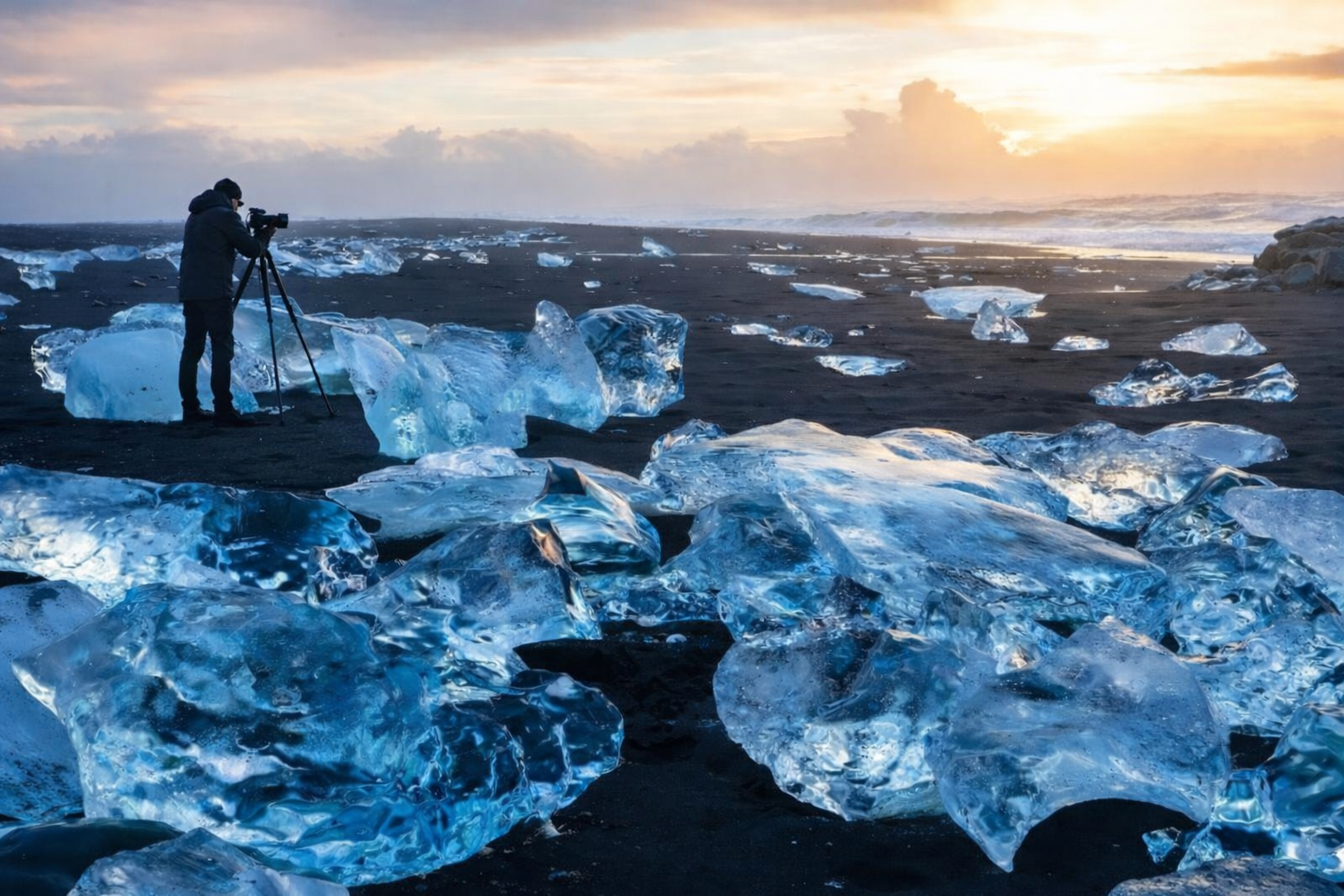
Not reliably. The ice on the beach starts as icebergs that break off the Breiðamerkurjökull glacier into Jökulsárlón, and most of it never leaves the lagoon. A study published in the Annals of Glaciology in 2017 found that virtually all of it melts there, because the channel to the sea is only about 70 m wide and 6 m deep. The smaller pieces that do get through are carried out by the river and washed back onto the black sand by the tide and the waves.
So the amount on the beach can change between one tide and the next, in every season. The lagoon's boat operator says ice conditions change daily, depending on glacier activity, weather, tides and ocean currents, and Vatnajökull National Park says ice from the lagoon often ends up on the beach. We found no official source that says winter or summer brings more ice to the sand. Diamond Beach is the popular name; on maps it is Fellsfjara, on both sides of the river mouth, with a car park on each side.
Does the tide matter?
Yes, in the sense that the tide moves the ice: pieces can arrive or drift away between one tide and the next. No source says whether low or high tide leaves more ice on the sand, and no tide prediction is published for the beach itself. The nearest published table is for the harbor at Höfn, about 80 km east by road, and the timing at the beach will differ; the date checker links to it.
Sunrise, sunset and the best time of day
No source ranks sunrise over sunset at Diamond Beach, and because the ice changes with the tides, waves and wind, no hour is reliably better for it. The position of the sun does change with the season. From October to February it rises in the south-east and sets in the south-west, over the sea side of the beach, and in December it never gets more than a few degrees above the horizon, so the light stays low all day. From April to August it rises and sets in the north, behind the lagoon and the land.
In December and January, sunrise is around 10:30 to 11 a.m. and sunset between about 3 and 4 p.m., so plan the drive so that you reach the beach in daylight. In June the sun sets after 11 p.m., and from late May to late July the sky stays in twilight all night. The date checker gives the exact times for your date.
A day tour from Reykjavík takes 14 to 15 hours, so in December and January much of it is spent on the road in the dark. Staying a night nearby gives you more of the short daylight at the beach. Our guide to where to stay compares the nearest options.
Tours by season
Checked September 23, 2026. Seasons are the ones each operator publishes; ratings and review counts are from GetYourGuide on that date.
Kayaking on Jökulsárlón is run by Ice Guide as a summer tour, and the smaller Fjallsárlón lagoon, 10 km west, runs its own boat tours from April to November.
Diamond Beach month by month
Daylight, sunrise and sunset are for the beach itself, in the middle of each month. Day highs and rain are long-term averages from Fagurhólsmýri, 30 km west along the same coast. Guest nights are the average for 2023 to 2025 in Hornafjörður, the municipality around the lagoon.
| Month | Daylight | Sunrise / sunset | Day high, Fagurhólsmýri | Rain in the month, Fagurhólsmýri | Guest nights, Hornafjörður | Tours nearby |
|---|---|---|---|---|---|---|
| January | 5h 24m | 10:32 a.m. / 3:55 p.m. | 3.9 °C | 171 mm | 18,600 | Ice caves; day tours |
| February | 8h 35m | 9:01 a.m. / 5:37 p.m. | 3.7 °C | 164 mm | 30,500 | Ice caves; day tours |
| March | 11h 38m | 7:25 a.m. / 7:03 p.m. | 4.4 °C | 155 mm | 41,500 | Ice caves; day tours |
| April | 15h 00m | 5:35 a.m. / 8:35 p.m. | 7.0 °C | 120 mm | 36,000 | Day tours; some ice caves |
| May | 18h 18m | 3:52 a.m. / 10:10 p.m. | 9.8 °C | 103 mm | 49,400 | Boat tours from early May; day tours |
| June | 20h 57m | 2:36 a.m. / 11:33 p.m. | 12.2 °C | 132 mm | 75,100 | Boat tours; day tours |
| July | 19h 45m | 3:18 a.m. / 11:03 p.m. | 13.8 °C | 101 mm | 94,200 | Boat tours; day tours |
| August | 16h 28m | 4:55 a.m. / 9:24 p.m. | 13.9 °C | 161 mm | 95,300 | Boat tours; day tours |
| September | 13h 07m | 6:26 a.m. / 7:34 p.m. | 11.4 °C | 190 mm | 72,900 | Boat tours; day tours |
| October | 9h 55m | 7:53 a.m. / 5:48 p.m. | 7.8 °C | 197 mm | 57,300 | Zodiac and amphibian boats; some ice caves; day tours |
| November | 6h 36m | 9:32 a.m. / 4:08 p.m. | 5.1 °C | 184 mm | 31,400 | Ice caves; amphibian boats to mid-month; day tours |
| December | 4h 17m | 10:51 a.m. / 3:09 p.m. | 4.1 °C | 182 mm | 22,400 | Ice caves; day tours |
Rain is the total for the whole month, not a daily figure. Every month gets over 100 mm at Fagurhólsmýri and 12 to 16 days with at least 1 mm, so pack waterproofs whenever you come; the difference between months is smaller than the difference between one day and the next. Guest nights count nights booked in the whole municipality, not people on the beach, and they miss the day tours from Reykjavík.
How busy it gets
No one counts visitors at Diamond Beach or Jökulsárlón by month. Vatnajökull National Park publishes only yearly totals, about 968,000 visitors to the lagoon area in 2023. Three other series agree on the pattern: guest nights in Hornafjörður and across South Iceland, and foreign visitors leaving through Keflavík airport, all peak in July and August and are lowest in December and January.
Two results matter when choosing a month. May has about half the July and August level of guest nights in Hornafjörður, well below the peak with the boats already running. And late winter is not the quiet part of the year: March had more guest nights than April and November in each of 2023, 2024 and 2025, and October more than May.
Wind, the road and safety on the day
On the day, three checks matter. The road: winter storms can temporarily close or restrict Route 1, so check road.is or umferdin.is on the morning you drive. Your tour: the lagoon's boat operator runs its tours depending on weather and ice conditions, and ice cave tours can be changed or cancelled for weather, so check your operator's status. The wind: strong wind makes the surf rougher and the walk on open sand harder, and it can delay or cancel tours. It is strongest from November to April, averaging about 8 m/s at Fagurhólsmýri, against about 6 m/s in July and August.
Safety at the water's edge
Safetravel, Iceland's travel safety service, says sneaker waves on the country's black-sand beaches can come with no warning, and advises staying well back from the water's edge and never turning your back on the sea. Its page is written for Reynisfjara, but Diamond Beach faces the same open Atlantic. To get between the lagoon and the beach on foot, use the path under the Route 1 bridge: the national park asks visitors not to walk over it. Our safety guide has more.
Parking
The beach is free to walk. Cars pay Vatnajökull National Park's daily regional fee: 1,110 ISK for a car with up to five seats, plus an 89 ISK fee to Parka, the payment service. One payment covers the lagoon and both beach car parks until midnight on the day you pay.
Northern lights at Diamond Beach
The sky does not get fully dark at the beach from about April 11 to September 2, so the northern lights are possible from early September to about April 10, and then only on a clear night with enough activity. Treat them as a possible bonus of a fall or winter trip, not the reason to choose a week. The Icelandic Met Office publishes a cloud and aurora forecast, and our northern lights guide covers the season across Iceland.
If you are still choosing dates for the whole trip, our best time to visit Iceland guide compares the seasons across the country.
Sources and methodology
How we checked the figures on this page
Tour seasons
Seasons are the ones each operator publishes on its own site, read on September 23, 2026, not the dates a booking calendar will accept. The Jökulsárlón boat operator (icelagoon.is) says its boat tours usually run from early May through October, lists the Zodiac as May to October with a minimum height of 130 cm, and gives amphibian tour hours into mid-November. For ice caves, Visit Vatnajökull gives November to usually March; Fjallsárlón ehf gives November to March; Glacier Adventure and Arctic Adventures publish tours from October or into April. After a fatal ice cave collapse on Breiðamerkurjökull in August 2024, the park tightened its rules, and summer ice cave tours were not run in the park in 2025, according to Iceland Review, Reykjavík Grapevine and RÚV; we found no final closure dates on a park page, so this page gives none. A search for closures at Jökulsárlón and Diamond Beach on September 23, 2026 found none; we will check again before November 1, 2026.
Weather
Day highs, lows, rain and wind are averages we calculated from the Icelandic Met Office's monthly records for its station at Fagurhólsmýri (745), 29.5 km west, over 1991 to 2008, when manned observations there ended. They are not an official 1991–2020 normal, which the Met Office does not publish for this coast. Rain at Skaftafell (748, 1991 to 2020) and Kvísker (740) was used as a cross-check; sunshine is from Hólar í Hornafirði (710, 1991 to 2011), about 55 km east. Wet days are from the Met Office's official 1961–1990 normal for Fagurhólsmýri. The date checker reads the Met Office's own forecast for its Kvísker road weather station (35315) over the daylight hours of your date; that forecast gives mean wind but no gusts.
Daylight and the sun
Sunrise, sunset and daylight are computed with the NOAA solar position algorithm for 64.048°N, 16.179°W, for the 15th of each month, and agree with public sunrise tables to within a few minutes. Iceland keeps the same clock all year, with no daylight saving time. The directions of sunrise and sunset are computed the same way. The beach is about 280 km south of the Arctic Circle, so there is no midnight sun.
Visitors
Guest nights are from Statistics Iceland table SAM01603 (registered accommodation, Hornafjörður municipality) for 2023, 2024 and 2025, averaged and rounded to the nearest hundred. South region guest nights (SAM01601), foreign departures through Keflavík (Icelandic Tourist Board) and the Skaftafell trail counter show the same peak and the same quiet months. Yearly visitor totals for the Jökulsárlón area are from Vatnajökull National Park's annual reports.
Ice, tides and parking
How the ice reaches the beach is from Brandon and others (2017), Annals of Glaciology 58(74), the lagoon operator's FAQ, Vatnajökull National Park's Fellsfjara page and Visit South Iceland. Parking fees are from the park's price list and Parka, read on September 23, 2026.
Where the evidence stops
- There is no monthly visitor count at the beach or the lagoon. Guest nights are a proxy for how busy the area is: they count nights booked across a large municipality and do not count day tours or people on the beach.
- The weather stations are 15 to 55 km away, and the Fagurhólsmýri record ends in 2008. They describe the same coast, not the beach to the degree.
- An average is not a forecast for your day, and a rain total does not count wet days.
- No source says whether one season, or one state of the tide, leaves more ice on the beach, and no tide prediction is published for the beach itself.
- No source ranks sunrise over sunset for photographs, and the figures here cannot tell you how much ice will be on the sand on any day.
- The date checker's forecast covers about ten days; beyond that it shows averages.
- Prices and review counts change; the booking page is the current figure.
Questions people ask
What is the best month to visit Diamond Beach?
If your dates are flexible, May and June offer the best overall balance for a first visit: boat tours are running, daylight is very long and you are ahead of the July and August peak. June has the fuller boat schedule, while May is generally quieter. If a natural ice cave is the main reason for your trip, choose November to March instead.
Is there more ice on Diamond Beach in winter or in summer?
Not reliably. The ice is carried out of Jökulsárlón by the river and washed back onto the sand by the tide and the waves, so the amount changes from day to day in every season. The lagoon's boat operator says ice conditions change daily, and no official source says one season brings more ice to the beach.
When do the boat tours on Jökulsárlón run?
The operator lists its Zodiac tours from May to October and its amphibian boat tours from May to November, with published hours running to November 15. Its FAQ says boat tours usually operate from early May through October, depending on weather and ice conditions, so check the schedule if you are going in late October or November. The Zodiac has a minimum height of 130 cm.
When is ice cave season near Diamond Beach?
November to March is the core season for natural ice caves in Vatnajökull, with some tours starting in October or continuing into April when conditions allow. The caves are visited only with a glacier guide.
Can you see the northern lights at Diamond Beach?
Yes, from early September to about April 10, when the sky gets dark enough at night. You also need a clear sky and enough aurora activity, so treat them as a possible bonus rather than something to plan a week around.
Is Diamond Beach worth visiting in summer?
Yes. Ice reaches the beach in every season, the boat tours on the lagoon are running, and the days are long enough to drive from Reykjavík and back in daylight. July and August are the busiest months, so May and June are the better summer choice if you can pick.
What is the best time of day to visit Diamond Beach?
No source ranks sunrise over sunset, and because the ice changes with the tides, waves and wind, no hour is reliably better for it. In December and January the beach is light only from about 10:30 a.m. to between 3 and 4 p.m., so plan the drive so that you reach the beach in daylight. From October to February the sun rises and sets over the sea side of the beach.
Does the tide affect the ice on Diamond Beach?
Yes. The tide and the waves wash the ice onto the sand and carry it away again, so the amount can change between one tide and the next. No source says whether low or high tide leaves more ice, and no tide prediction is published for the beach itself; the nearest harbor table is for Höfn.
Is Diamond Beach free to visit?
The beach is free to walk. Cars pay Vatnajökull National Park's daily regional fee, 1,110 ISK for a car with up to five seats plus an 89 ISK payment fee, and one payment covers the lagoon and both beach car parks until midnight.