Step out of an Icelandic winter day into a tunnel where the light turns electric blue, the walls glow like frozen sapphire and the only sound is meltwater dripping from the roof. You are standing inside a glacier, in a cave that did not exist last year and will be gone by next year. The best-known of these caves form under Vatnajökull, a short drive from Jökulsárlón Glacier Lagoon and Diamond Beach, and tours into them leave from the lagoon car park. Here is how to plan a visit safely.
In short
- Iceland's famous natural blue ice caves, sold under names like "Crystal", "Sapphire" and "Blue Diamond", form each winter under Breiðamerkurjökull, an outlet glacier of Vatnajökull. Tours leave from the Jökulsárlón car park next to Diamond Beach, and the season runs roughly from mid-October or November to March or April.
- You can only enter a natural ice cave with a certified glacier guide. That rule was reinforced after a 30-year-old American man was killed in an ice cave collapse on Breiðamerkurjökull in August 2024, and natural ice caving inside Vatnajökull National Park is no longer allowed in summer.
- Two options run all year for summer visitors: the natural, ash-streaked Katla ice cave near Vík and the man-made Into the Glacier tunnel in Langjökull, reached from Húsafell.
Check live dates and prices for the Original Ice Cave Tour on Vatnajökull, which meets at Jökulsárlón (4.6★ from 1,131 reviews on GetYourGuide):
What Ice Caves Are and How They Form
Iceland's glacial ice caves form when summer meltwater and rain drain down through moulins and crevasses to the base of a glacier and carve tunnels through the ice. In summer those passages are full of rushing water. When the winter cold arrives and melting stops, the water drains away and the carved chambers become reachable and relatively stable. That is why the caves are short-lived: each summer reshapes or destroys them, no two winters produce the same caves, and guides have to find new entrances every autumn.
The intense blue comes from the density of the ice. Over centuries, compressed snow turns into dense glacier ice with the air bubbles squeezed out. That ice absorbs the longer red and yellow wavelengths of light and lets the shorter blue wavelengths through. The colour is most vivid on overcast days. Iceland's volcanoes add the drama: layers of ash trapped in the ice show up as black and grey stripes, most famously in the Katla cave.
A note on the words. Strictly, a cave formed entirely inside a glacier is a glacier cave, and "ice cave" is the broader term. In everyday travel use, "ice cave" has become the popular name for Iceland's glacier caves. Man-made ice tunnels are a different thing: engineered passages cut into a glacier, stable all year, but without the meltwater-sculpted walls of the natural blue caves.
Other Experiences You Might Enjoy
An ice cave is usually one stop on a longer trip along the South Coast. Popular pairings include a Jökulsárlón glacier lagoon visit and Diamond Beach, a Skaftafell glacier hike on Vatnajökull, the Seljalandsfoss and Skógafoss waterfalls, Reynisfjara black sand beach near Vík, and a winter northern lights tour. The tours below are pulled live from GetYourGuide and update automatically.
Types of Ice Caves You Can Visit in Iceland
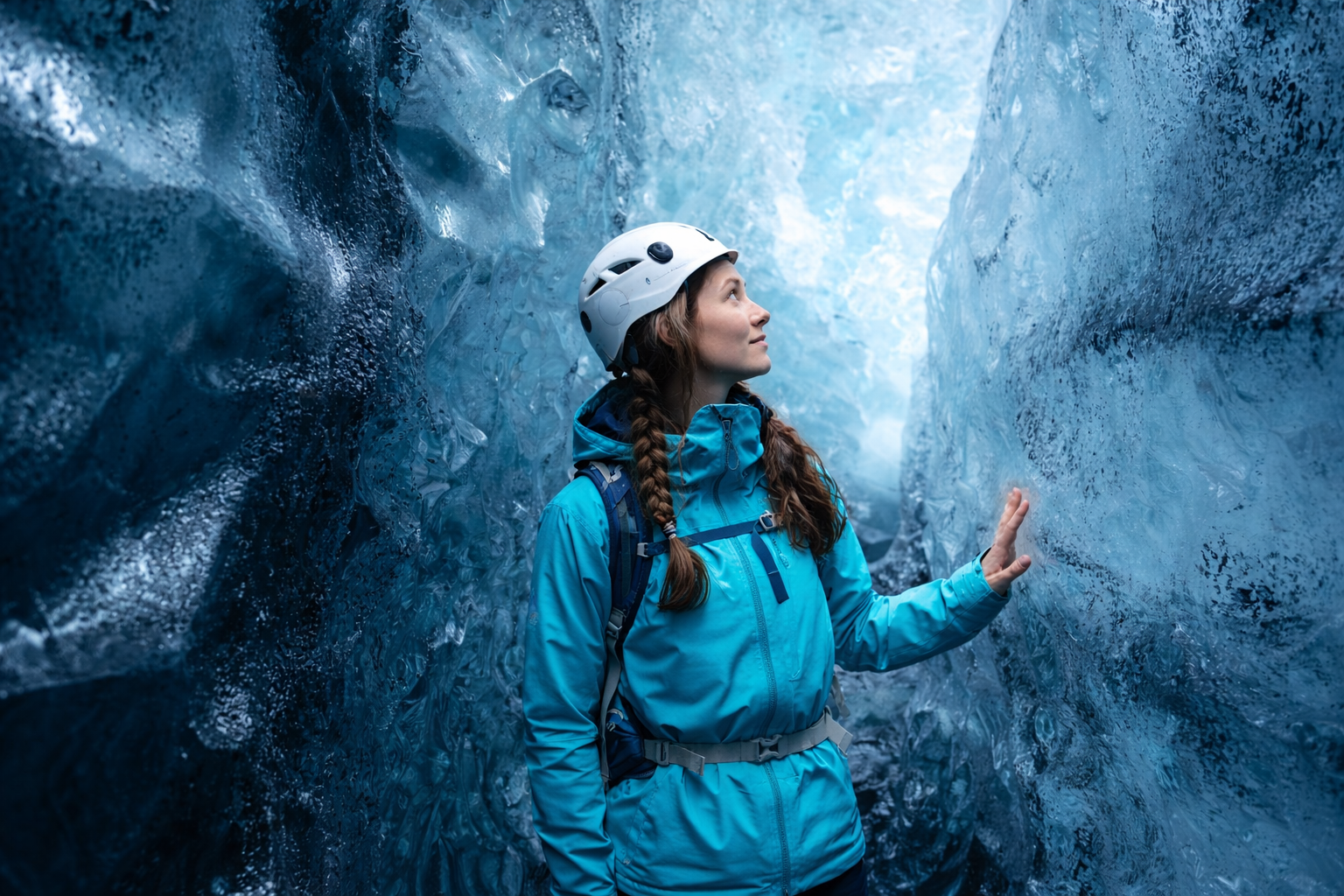
1. The natural blue ice caves under Vatnajökull (by Jökulsárlón)
Most of Iceland's natural ice caves form in the outlet glaciers of Vatnajökull, Europe's largest glacier by volume, and above all in Breiðamerkurjökull, the glacier that feeds Jökulsárlón. Sold together as "the Blue Ice Caves", they turn up each year under names like "Crystal Cave", "Sapphire Cave" and "Blue Diamond". The names are mostly marketing: the cave itself changes every season. These caves are winter-only, and tours leave from the Jökulsárlón area: the Original Ice Cave Tour (4.6★ from 1,131 reviews on GetYourGuide), the Blue Ice Cave Tour from Jökulsárlón (4.6★ from 963 reviews on GetYourGuide) and the Vatnajökull Ice Cave Guided Tour (4.3★ from 2,174 reviews on GetYourGuide) all meet at the lagoon. Our Vatnajökull ice cave tours page covers the Jökulsárlón and Fjallsárlón departures in more detail.
There are also caves on the Skaftafell side of Vatnajökull, often open and canyon-like, which suit anyone who dislikes enclosed spaces. The Skaftafell ice cave and glacier hike (4.5★ from 1,966 reviews on GetYourGuide) and the Skaftafell blue ice cave and glacier hike (4.6★ from 852 reviews on GetYourGuide) both start there.
2. The Katla ice cave (Kötlujökull, Mýrdalsjökull, near Vík)
This natural cave sits under Kötlujökull, an outlet of the Mýrdalsjökull ice cap. It is one of the very few natural ice caves you can visit all year, and it is known for its mix of blue ice and black volcanic ash. Tours leave from Vík: the Katla ice cave tour from Vík (4.4★ from 1,344 reviews on GetYourGuide) goes in by super jeep, and the South Coast and Katla ice cave tour from Reykjavík (4.7★ from 779 reviews on GetYourGuide) adds the waterfalls and the black beach on a long day out.
3. Into the Glacier, the man-made tunnel in Langjökull (near Húsafell)
A tunnel drilled into Langjökull, Iceland's second-largest glacier. At about 500 metres long it is billed as the world's largest man-made ice tunnel, and it has a small chapel carved into the ice. It is open all year, and you ride up the glacier in a specially modified eight-wheel glacier truck. From mid-October to the end of May tours leave from Húsafell, about a 2-hour drive from Reykjavík; from June to mid-October they leave from the operator's Klaki base camp. The Into the Glacier tour from Húsafell (4.7★ from 866 reviews on GetYourGuide) takes about 4 hours, and the Into the Glacier tour from Reykjavík (4.6★ from 204 reviews on GetYourGuide) makes it an 11-hour day with transport.
4. Other and newer caves
Guides keep finding new caves. The Neptune Ice Cave on Langjökull was discovered by Arctic Adventures guides in October 2025, with tours running until April 2026. Arctic Adventures run their winter snowmobile and ice cave trips on the same glacier; the Langjökull snowmobile and ice cave tour from Reykjavík (4.6★ from 154 reviews on GetYourGuide) visits whichever cave is safe that season. In Reykjavík, the Perlan museum has a purpose-built indoor ice cave exhibit. The Perlan Wonders of Iceland ticket (4.7★ from 4,339 reviews on GetYourGuide) includes it, which makes it a good fallback on a day when the weather cancels a glacier trip.
When Is Ice Cave Season?
The traditional natural ice cave season runs roughly from November to March, and some operators run from mid-October to April. Winter is the only safe time for natural caves: the cold hardens and stabilises the ice, while in Iceland's long summer days a cave's walls and roof can melt and thin by about 10 cm a day, according to geophysicist Magnús Tumi Guðmundsson. Inside Vatnajökull National Park the natural caves have been closed in summer since the 2024 accident (in 2025, from May to September). Because everything depends on conditions, tours can be cancelled at short notice.
If you want a natural blue cave, plan a winter trip. If you are visiting in summer, your options are the year-round Katla cave or the Into the Glacier tunnel. Our best time to visit Diamond Beach guide shows how the ice cave season fits with the boat tours on the lagoon, which run in the other half of the year.
Where Tours Depart and How to Get There
The hub for the Vatnajökull blue caves is the Jökulsárlón Glacier Lagoon car park, about 370–380 km (roughly a 5-hour drive) east of Reykjavík, right next to Diamond Beach. Our Jökulsárlón Glacier Lagoon guide and Diamond Beach Complete Guide cover the area. Because of the distance, a same-day round trip from Reykjavík just for the caves is a very long day. Most people stay overnight near the lagoon (see where to stay near Diamond Beach) or fold the cave into a multi-day South Coast trip such as the 2-day South Coast tour with a blue ice cave (4.7★ from 261 reviews on GetYourGuide).
The Katla cave leaves from Vík, about a 2.5-hour drive from Reykjavík, so it works as a long day trip. Into the Glacier leaves from Húsafell, about 2 hours from Reykjavík, and also works as a day trip. Driving yourself in winter? Read our directions and winter driving guide first.
Guided Tours Only: the Rule That Matters Most
Never enter a natural ice cave without a certified glacier guide
Glaciers are riddled with hidden crevasses, and ice caves can flood, collapse or shed ice without warning. Guides scout and assess the caves every day. Inside Vatnajökull National Park, visiting ice caves without a guide is prohibited.
A typical tour includes a super-jeep transfer to the edge of the glacier, crampons or microspikes, a helmet and a certified guide. The shorter crystal cave tours from Jökulsárlón take about 2.5–4 hours; longer "extreme" tours run 5–6 hours or more. Minimum ages are commonly 8–10 for natural caves. Into the Glacier is the most family-friendly option.
What to Expect on a Tour
Most crystal cave tours from Jökulsárlón start at the lagoon car park, where you meet your guide and get a safety briefing. Then comes a 20–30 minute off-road super-jeep ride and a short walk to the entrance. Inside, you have roughly 30 minutes to 1.5 hours to explore and take photographs.
What to Wear and Bring
- Sturdy, waterproof hiking boots. This is the one item that matters most, because the crampons strap onto them; trainers will not work. Many operators rent boots and waterproofs.
- Warm, waterproof layers. Avoid jeans.
- A warm hat that fits under a helmet, and gloves.
- A camera.
- Provided by the operator: crampons and a helmet.
Our practical guide has a full winter packing list for the Jökulsárlón area.
How Much Do Ice Cave Tours Cost?
As a rough guide, natural crystal and blue ice cave tours from Jökulsárlón cost around 20,000–30,000 ISK per person for the standard 2.5–3.5 hour tour, with several operators around 22,000–25,000 ISK. Longer combinations and private tours cost more. Prices change with the season and the operator, so confirm when you book.
| Ice cave | Season | Departs from | Our pick on GetYourGuide |
|---|---|---|---|
| Vatnajökull blue caves | Winter only | Jökulsárlón | The Original Ice Cave Tour, from $161, 4.6★ (1,131) |
| Skaftafell ice cave and glacier hike | Winter only | Skaftafell | Ice cave tour and glacier hike, from $160, 4.5★ (1,966) |
| Katla ice cave | Year-round | Vík | Katla ice cave small-group tour, from $181, 4.4★ (1,344) |
| Katla with the South Coast | Year-round | Reykjavík | South Coast and Katla ice cave tour, from $273, 4.7★ (779) |
| Into the Glacier tunnel | Year-round | Húsafell or Reykjavík | Into the Glacier from Húsafell, 4.7★ (866) |
| Blue cave on a 2-day trip | Winter only | Reykjavík | 2-day South Coast tour with blue ice cave, from $731, 4.7★ (261) |
Dollar prices are GetYourGuide's starting prices per person; ratings and review counts were checked on GetYourGuide on 3 October 2026.
Photography Tips
Ice caves are dim, so a tripod is essential. A wide-angle lens captures the scale and the blue tones, and a microfibre cloth deals with grit and dripping water. Shoot at a low ISO (100–400), stop down to around f/8–f/13, and watch your histogram so the bright cave entrance does not blow out. Put a person in the frame for scale. Our Diamond Beach photography guide covers the ice on the beach outside.
Safety in Depth, and the 2024 Collapse
Glaciers are genuinely hazardous: crevasses hide under snow bridges, ice collapses without warning and caves flood. Weather can force a cancellation at any time. Always listen to your guide.
The risks became tragically real on Sunday 25 August 2024, when ice collapsed during a tour on Breiðamerkurjökull, at a cave reported as the "Blue Flame". A 30-year-old American man was killed and his pregnant wife was seriously injured. It was reported as the first fatal accident on an ice cave tour in the national park, and it happened in warm summer weather, the conditions experts had long warned against. A 2017 risk assessment for the park, co-authored by University of Iceland geophysicist Magnús Tumi Guðmundsson, had concluded that the whole summer is high-risk for ice caves and that tours should not run then.
After the accident, ice cave tours in the park were halted until 31 October 2024. Under new contracts in force from 1 November 2024, operators must run daily risk assessments overseen by an expert council, and group sizes per guide are capped. Natural ice caving inside Vatnajökull National Park is no longer allowed in summer: in practice the season for natural caves now runs roughly from October to April, with the core months November to March. Ice cave tours on glaciers outside the national park, including the year-round Katla cave, are far less regulated, and experts continue to warn against natural caving there in summer.
The Best Ice Caves for Your Trip
- Year-round or summer: Katla (natural, near Vík) and Into the Glacier (man-made, near Húsafell).
- The most beautiful blue ice: the natural caves under Vatnajökull and Breiðamerkurjökull (winter only).
- Easiest and most family-friendly: the Into the Glacier tunnel.
- Closest to Reykjavík: Into the Glacier in Langjökull, and Katla.
- If enclosed spaces bother you: the open, canyon-like caves on the Skaftafell side.
Combining an Ice Cave with Other Attractions
The blue caves pair naturally with the rest of the Jökulsárlón and Vatnajökull area: the lagoon itself, Diamond Beach, Skaftafell and, because you are there in the dark season, the northern lights (see our Northern Lights guide and best time to see the Northern Lights). A Katla trip combines with the black sand beaches and the waterfalls of the South Coast (4.8★ from 12,712 reviews on GetYourGuide), while Into the Glacier pairs with the Golden Circle (4.8★ from 27,561 reviews on GetYourGuide).
What Changed for 2025 and 2026
Operators reported strong natural-cave conditions for the 2025–26 winter, and the newly found Neptune cave opened on Langjökull in October 2025 with tours until April 2026. The biggest change is in the rules: natural ice caving inside Vatnajökull National Park is no longer allowed in summer, and operators must run daily safety assessments. If you want a natural blue cave, it is a winter-only trip.
Our Recommendations
- For the classic blue crystal cave: plan a winter trip (roughly November to March), stay at least one night near Jökulsárlón and Diamond Beach, and book a guided tour such as the Original Ice Cave Tour in advance. You will be there in the dark season, so add a northern lights hunt.
- In summer, or for the easiest option: choose the year-round Katla cave from Vík or the man-made Into the Glacier tunnel from Húsafell.
- Book with a certified, reputable operator, and never attempt a cave on your own.
- Pack waterproof hiking boots and waterproof layers, and rent them if you do not own them.
- Leave spare days: weather cancellations are common.
Before You Book
- Natural caves change every year. Cave names are marketing labels for whichever cave is safe and reachable that season.
- Prices, minimum ages and durations vary by operator and season.
- Conditions and rules change. Check SafeTravel.is, road.is and the Vatnajökull National Park website before you travel.
Frequently Asked Questions
Natural blue ice caves are a winter activity, roughly November to March (some operators run from mid-October to April). The Katla cave and the Into the Glacier tunnel are open year-round.
The most famous natural caves are in Vatnajökull (Breiðamerkurjökull) near Jökulsárlón in the southeast. The Katla cave is under Mýrdalsjökull near Vík, and the man-made Into the Glacier tunnel is in Langjökull near Húsafell in the west.
No. Never enter a natural ice cave without a certified glacier guide, and inside Vatnajökull National Park it is prohibited.
Standard natural crystal cave tours from Jökulsárlón cost roughly 20,000–30,000 ISK per person. Katla and Into the Glacier are priced separately.
Not the natural blue caves in Vatnajökull: natural ice caving in the national park is no longer allowed in summer, for safety. In summer, visit the year-round Katla cave or the Into the Glacier tunnel.
Yes, when you go on a guided tour in season with a certified operator. The fatal collapse on Breiðamerkurjökull on 25 August 2024, which killed one visitor, happened in summer, the conditions experts warn against, and led to stricter rules and a summer ban on natural ice caving inside the national park.
Vatnajökull's caves are vivid blue and winter-only. Katla is darker, streaked with black volcanic ash, and open year-round. Vatnajökull tours leave from Jökulsárlón; Katla tours leave from Vík.
For the Vatnajökull blue caves, drive about 370–380 km (roughly 5 hours) east on Route 1 to Jökulsárlón, where the tours start; most people stay nearby. Katla (from Vík) and Into the Glacier (from Húsafell) are 2–2.5 hours from Reykjavík and work as day trips.