Skaftafell sits between Europe's largest ice cap and the North Atlantic. Glacier tongues slide down from Vatnajökull towards green birch woodland, Svartifoss drops over a cliff of black basalt columns, and Iceland's highest peak rises behind it all. It was once a national park of its own and is now the most visited part of Vatnajökull National Park, a UNESCO World Heritage Site that covers roughly 14% of Iceland. Most people come to walk to Svartifoss or to strap on crampons for a guided glacier hike, and it lies right on the Ring Road, just under an hour west of Jökulsárlón and Diamond Beach. Below are the trails, the glacier trips, the fees and how to fit it into your drive.
The trip most visitors book here is a guided walk on the ice. Check live dates and prices for the small-group Skaftafell glacier hike (4.7★ from 1,637 reviews on GetYourGuide), which meets at the visitor centre and runs all year:
Skaftafell at a glance
- Where: just off Route 1 in southeast Iceland, about 327 km from Reykjavík and 55–60 km west of Diamond Beach.
- Entry: free. Parking at the visitor centre is 1,110 ISK per car, valid until midnight.
- Must-do walk: Svartifoss, about 3 km return, 1.5–2 hours.
- Glaciers: walk on the ice only with a certified guide; hidden crevasses make it dangerous on your own.
What Is Skaftafell?
Skaftafell is a wilderness area on the southern edge of the Vatnajökull ice cap in southeast Iceland. It became a national park in its own right in 1967 and was folded into the much larger Vatnajökull National Park when that park was created in 2008. Today it is the park's main southern hub and visitor gateway.
What makes Skaftafell special is the contrast. Sheltered birch woodland and green hills sit right below bare glaciers and jagged peaks. The mountains shield it somewhat from the coastal weather, so conditions are relatively kind for this part of Iceland. It is a favourite place for hiking, glacier walking and photography. Glacier tongues pour off Vatnajökull on both sides, the best known being Skaftafellsjökull, framed by steep mountains.
Vatnajökull National Park and UNESCO Status
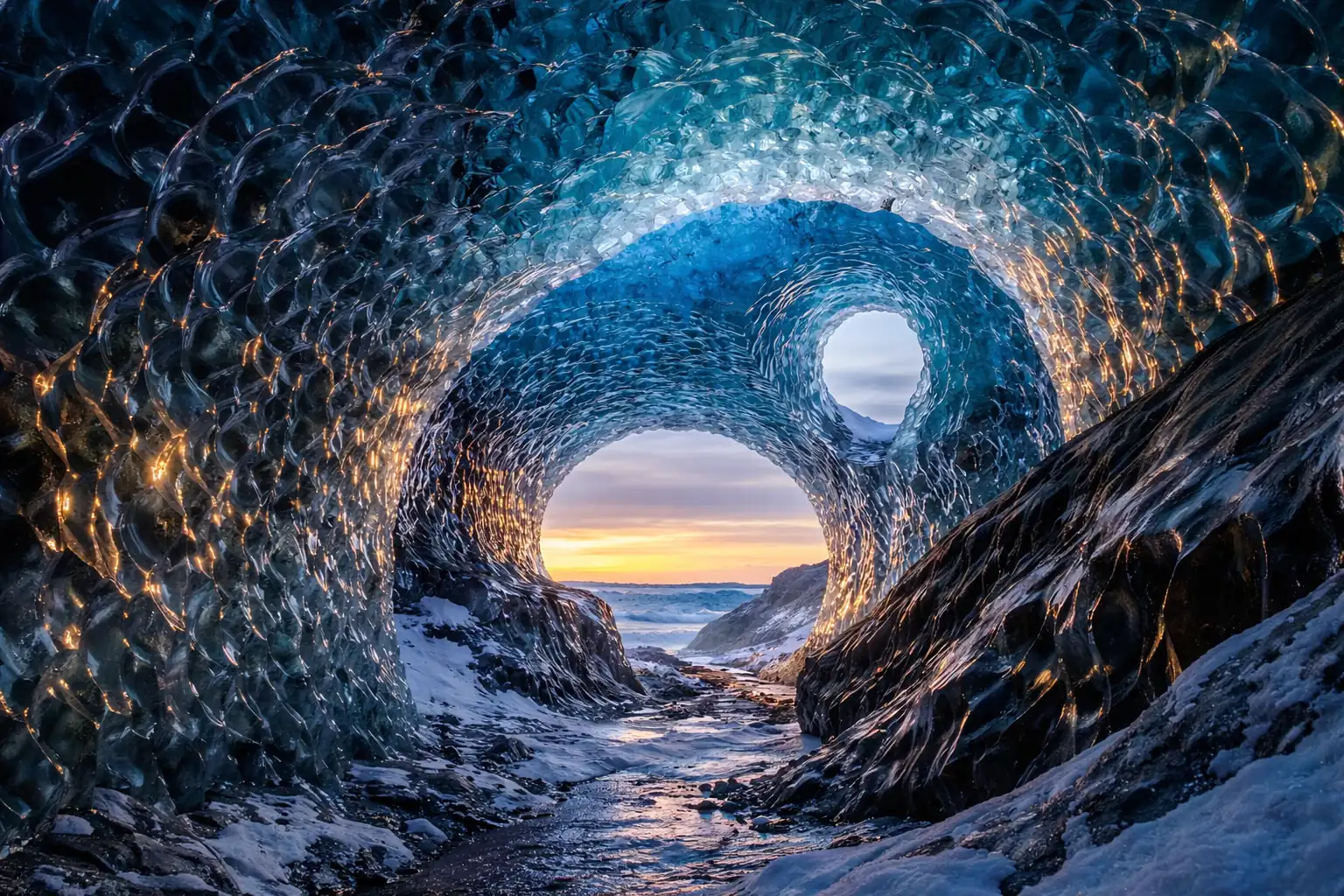
Vatnajökull National Park is one of the largest national parks in Europe, covering roughly 14% of Iceland, more than 14,000 km². At its heart is Vatnajökull, the largest ice cap in Europe by volume, with active volcanoes and subglacial lakes hidden beneath the ice.
In 2019 the park was inscribed as a UNESCO World Heritage Site under the title "Vatnajökull National Park – Dynamic Nature of Fire and Ice". The listing recognises how ice and volcanic activity work on each other here: glaciers, volcanoes, jökulhlaups (glacial floods) and the landscapes they leave behind. Fire and ice is the park's defining theme, and Iceland's glaciers explained covers how the ice forms and moves.
The park is usually described by its regions. Skaftafell, in the south, is the most visited and the easiest to reach, with its trails, glacier tours and a location on the Ring Road. Jökulsárlón is also part of the park; our guide to the attractions near Diamond Beach covers the lagoon, its boat tours and Fjallsárlón.
Other Experiences You Might Enjoy
Most people visit Skaftafell on a South Coast road trip that also takes in Svartifoss, a Vatnajökull glacier hike on Falljökull, a winter blue ice cave tour, Jökulsárlón Glacier Lagoon and Diamond Beach, and a Northern Lights hunt in southeast Iceland. The tours below are pulled live from GetYourGuide and update automatically.
Where Is Skaftafell and How to Get There
Skaftafell lies directly off Route 1 (the Ring Road) in southeast Iceland.
| From | Distance by road | Drive time |
|---|---|---|
| Reykjavík | about 327 km | roughly 4.5–5 hours |
| Vík | about 140 km | roughly 1.5–2 hours |
| Jökulsárlón and Diamond Beach | about 55–60 km | roughly 45 minutes |
| Höfn | about 130 km | roughly 1.5 hours |
The Skaftafell Visitor Centre is well signposted from Route 1 and is the hub for every trail, with parking, information, exhibits, toilets and a café. Most visitors drive themselves, and some guided South Coast and Ring Road tours stop here too: if you would rather not drive, the 2-day South Coast tour with blue ice cave (4.7★ from 263 reviews on GetYourGuide) travels this stretch from Reykjavík, so check its itinerary for a Skaftafell stop. The road is paved and open all year, but winter driving needs care. Our Reykjavík to Diamond Beach driving guide covers the whole route.
The Skaftafell Visitor Centre
The Skaftafell Visitor Centre (Skaftafellsstofa) is where every visit starts. You will find:
- Park information and trail maps, plus rangers who can tell you about conditions.
- Exhibitions on the park's geology, glaciers and ecology.
- Toilets, a café and shop, and a large paid car park.
- Meeting points for guided glacier hikes and ice cave tours.
- A campsite next to the centre.
Stop here to check trail and weather conditions, pay for parking, and book or meet your glacier tour before you set out.
Top Things to Do in Skaftafell
1. Hike to Svartifoss, the "Black Waterfall"
The most famous sight in Skaftafell is Svartifoss, or "Black Falls", a slender waterfall framed by dark hexagonal basalt columns. The columns formed as lava cooled slowly and contracted, cracking into six-sided pillars, the same process that shaped the Giant's Causeway. Their organ-pipe look inspired Icelandic architects, including the designs of Reykjavík's Hallgrímskirkja church and the National Theatre.
The trail from the visitor centre is about 1.5 km each way, roughly 3 km return, with a steady climb of about 140 metres. Allow 1.5–2 hours. On the way up you pass two smaller waterfalls, Hundafoss and Þjófafoss. If you only do one walk in Skaftafell, make it this one.
2. Glacier Hiking
Skaftafell is one of the best and most popular places in Iceland for guided glacier hikes. Tours head onto the Falljökull and Skaftafellsjökull glacier tongues. You strap on crampons, carry an ice axe and wear a helmet, and walk among crevasses, sinkholes, ice formations and ridges of blue ice.
- Tours range from beginner-friendly 1.5–3 hour walks to demanding half-day and full-day treks. The small-group Skaftafell glacier hike (4.7★ from 1,637 reviews on GetYourGuide) is the easy, most-reviewed option.
- Guided only: never walk on a glacier without a certified guide and proper equipment. Hidden crevasses and unstable ice make it genuinely dangerous.
- Tours run all year and leave from the visitor centre area.
For many people a glacier hike here is the highlight of the whole trip, and the shorter walks suit reasonably fit beginners.
3. Ice Caves (Winter)
In winter, Skaftafell is a departure point for ice cave tours. Some visit the famous blue crystal caves in the wider Vatnajökull area. Others explore caves near Skaftafell that are often more open and canyon-like, a good choice if enclosed caves make you feel claustrophobic. The Skaftafell ice cave and glacier hike (4.5★ from 2,011 reviews on GetYourGuide, from $160) pairs a cave with a walk on Falljökull, and the Skaftafell blue ice cave and glacier hike (4.6★ from 930 reviews) does the same with a blue ice cave. Natural ice caves can only be visited in winter, roughly November to March, with some operators starting in mid-October and running into April, and only with a guide. Our ice caves in Iceland guide compares the caves and seasons.
4. Hiking the Trails
Beyond Svartifoss, Skaftafell has a network of marked trails for every level, from a flat stroll to a full mountain day (see the next section).
5. See the Skaftafellsjökull Glacier Tongue
An easy, mostly flat walk takes you to the edge of the Skaftafellsjökull glacier tongue and its lagoon, the easiest way to stand in front of a glacier.
Best Hiking Trails in Skaftafell
Distances and times below are the national park's own figures where it publishes them.
| Trail | Distance | Time | What you see |
|---|---|---|---|
| Svartifoss–Sjónarsker–Sel loop | 5.8 km loop | about 2 hours | The classic: Svartifoss, the Sjónarsker viewpoint and the Sel turf farmhouse. The park rates it easy, with about 250 m of climbing. |
| Skaftafellsjökull glacier trail | 4.1 km loop | 1–1.5 hours | Easy and mostly flat, to the glacier tongue and its lagoon. |
| Svínafellsjökull viewpoint | short walk | varies | Another dramatic glacier tongue, a filming location for Interstellar and Batman Begins. Check access and conditions locally. |
| Kristínartindar | 18 km | 6–8 hours | A difficult full-day summit hike with views over glaciers and mountains, for experienced, fit hikers in summer. |
| Morsárdalur and Bæjarstaðarskógur | long valley hike | full day | A birch woodland and the Morsá river, with views towards Morsárfoss, one of Iceland's tallest waterfalls. |
Always check trail conditions at the visitor centre before a longer hike, and be ready for the weather to change quickly.
Iceland's Highest Peak: Hvannadalshnúkur
Inside the park rises Hvannadalshnúkur, Iceland's highest peak at 2,110 metres (6,923 feet). It is a pinnacle on the rim of Öræfajökull, an ice-covered stratovolcano that forms part of the Vatnajökull ice cap.
Climbing Hvannadalshnúkur is a serious guided mountaineering day, often 10–15 hours long. You need good fitness, crampons, ropes and some glacier experience, and most attempts are made in spring and early summer. Most visitors admire it from below; for experienced climbers it is a bucket-list summit. We could not find a guided climb sold on GetYourGuide, so book directly with a local mountain guiding company.
The park is also home to Morsárfoss, which appeared as the glacier retreated around 2007 and is considered Iceland's tallest waterfall, at roughly 227–240 metres.
Best Time to Visit Skaftafell
You can visit Skaftafell all year, and each season suits a different kind of trip:
- Summer (June–August): the best time for hiking, with long daylight, milder weather, every trail open, green woodland and wildflowers. Glacier hikes run daily. This is the busiest season.
- Autumn (September–October): fewer people, autumn colours, good hiking early in the season and the return of the aurora.
- Winter (November–March): the season for ice caves, snowy glacier hikes and the Northern Lights. Some higher trails close or become hazardous, and short days and winter roads need planning.
- Spring (April–May): longer days, thawing trails and fewer people.
If hiking is the point, come in summer or early autumn; for ice caves and the aurora, come in winter. Our best time to visit Diamond Beach guide has month-by-month tours, daylight and weather for this stretch of coast.
Practical Info and 2026 Fees
- Park entry: Vatnajökull National Park has no general entrance fee, so entering and hiking are free.
- Parking: you pay to park at the Skaftafell Visitor Centre. The park's 2026 price list gives 1,110 ISK per car with up to five seats, valid until midnight, paid at the machines or in the Parka app. Keep your receipt: if you park in a second fee area of the park on the same day, such as Jökulsárlón, you pay half price there, and the same works in reverse.
- Facilities: the visitor centre has a café and shop, toilets, information and exhibitions, with a campsite beside it. Fuel and other services nearby are limited; the nearest town is Höfn.
- Guided tours: book glacier hikes and ice caves ahead, especially in peak season. Most meet at the visitor centre.
- Time to spend: half a day covers the Svartifoss hike and the glacier tongue; allow a full day or more if you add a glacier hike, an ice cave or a longer trail.
Check the current fees on the park's official price list before you go.
Safety Tips
- Never walk on a glacier without a certified guide and proper equipment. Hidden crevasses and unstable ice can kill.
- Check the weather and trail conditions at the visitor centre and on vedur.is and road.is before you hike.
- Wear warm, waterproof and windproof layers and sturdy hiking boots: mountain weather changes fast, even in summer.
- Stay on marked trails to protect the fragile vegetation and to stay safe.
- Visit ice caves only in winter and only with a guide. Never enter one on your own.
- Carry water, snacks and a charged phone on longer hikes.
Our Diamond Beach safety tips cover the hazards on the beach and lagoon further east.
Combining Skaftafell with Nearby Attractions
Skaftafell sits right on the route to the biggest sights in southeast Iceland:
- Jökulsárlón Glacier Lagoon and Diamond Beach, about 45 minutes east: the region's star attractions and a natural pairing (remember the half-price parking). In winter, the Original Ice Cave Tour from Jökulsárlón (4.6★ from 1,207 reviews on GetYourGuide, from $161) leaves from the lagoon. See our Diamond Beach guide and our Jökulsárlón and nearby attractions guide.
- Svínafellsjökull, a short drive away: a dramatic glacier tongue known from the films.
- Fjaðrárgljúfur, a spectacular canyon to the west near Kirkjubæjarklaustur.
- Vestrahorn and Stokksnes, the photogenic mountain near Höfn, further east. Our Vestrahorn guide covers the entry fee and the best light.
- Höfn, the nearest town, good for langoustine and a bed for the night. See where to stay near Diamond Beach.
Most travellers visit Skaftafell on a South Coast trip to Diamond Beach or a full Ring Road journey, often spending the night near Skaftafell or in Höfn. If you are flying into Reykjavík, the first day often goes on the Golden Circle before you head east. Our Iceland itineraries and Reykjavík to Diamond Beach guide help you plan the days.
Frequently Asked Questions
Svartifoss, the waterfall framed by black basalt columns; glacier tongues such as Skaftafellsjökull and the guided glacier hikes on them; well-marked hiking trails; winter ice cave tours; and its role as the main southern gateway to Vatnajökull National Park. Iceland's highest peak, Hvannadalshnúkur, also lies within the park.
No. The park has no general entrance fee, so entering and hiking are free. You do pay for parking at the Skaftafell Visitor Centre: 1,110 ISK for a car with up to five seats, valid until midnight. If you park in another of the park's fee areas the same day, such as Jökulsárlón, the second fee is half price.
About 327 km, a drive of roughly 4.5–5 hours east along Route 1. It is around 45 minutes west of Jökulsárlón and Diamond Beach.
About 1.5 km each way from the visitor centre, so roughly 3 km return, with a climb of about 140 metres. Allow 1.5–2 hours. If you come back via the Sjónarsker viewpoint and the Sel turf farm, the park's loop is 5.8 km and takes about 2 hours.
Yes. Skaftafell is one of Iceland's main places for guided glacier hikes on the Falljökull and Skaftafellsjökull tongues, from short beginner walks such as the small-group Skaftafell glacier hike to full-day treks. Go only with a certified guide and proper equipment, and never walk onto a glacier on your own.
Yes, in winter: roughly November to March, with some operators starting in mid-October and running into April. Guided tours leave from the area for blue ice caves in Vatnajökull and for more open, canyon-like caves near Skaftafell. Ice caves are guided-only.
Hvannadalshnúkur, at 2,110 metres, on the rim of the Öræfajökull volcano within Vatnajökull National Park. Climbing it is a serious guided mountaineering day of 10–15 hours.
Summer and early autumn are best for hiking, with long days and open trails; winter is the time for ice caves and the Northern Lights. You can visit all year, but plan for short daylight and winter driving in the colder months.